
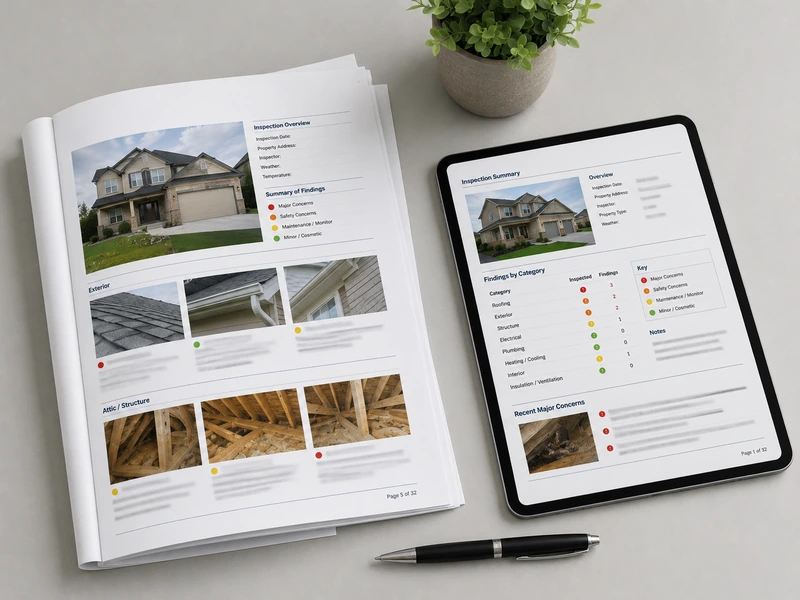
A long report is not a bad house. New buyers open a fifty-item document, see the length, and panic — when most of those items are the ordinary condition of a building that people have lived in. Reading a report well is mostly about sorting.
Read the ranking, not the count
A useful report ranks findings by consequence. The number of items tells you how thorough the inspector was; the ranking tells you what to do. If everything in a report carries the same weight, that is a problem with the report, not a description of the house.
Sort what you are reading into three buckets:
- Safety. Deal with these regardless of price. Electrical hazards, gas, anything about to fail on someone.
- Money. Systems near the end of service life, active water entry, structural concerns. These are what a price conversation is actually about.
- Maintenance. The long tail. Worth doing, not worth renegotiating over.
Ask yourself one question per finding: does this change what the property is worth to me, or is it a job for a Saturday? Most items are the second.
Why every finding should have a photograph
Because you will be reading this at a kitchen table days later, possibly forwarding it to a contractor who was never at the property. A described crack is an argument; a photographed crack with a location is evidence. It is also how you check the report against the house on your second visit.
Limitation language is information
Phrases like "not accessible", "not tested" and "concealed by finishes" are not filler. They tell you where the report stops, and therefore where your remaining risk sits. A finished basement means the foundation walls were largely unseen. Snow on the roof means the covering was not walked. That is worth knowing before you waive a condition.
Be more concerned by a report that mentions no limitations at all. Every inspection has them.
"Recommend further evaluation"
This is not the inspector hedging. A general inspection is visual and non-invasive; some conditions genuinely need a specialist, a licensed trade, or a formal engineering assessment to characterise. When a report says this, it is telling you that the next step is a specific one — and that acting on it before your conditions come off is usually cheaper than acting on it after.
Reading the summary against the body
Most reports open with a summary. It is the right place to start and the wrong place to stop. Summaries compress, and compression loses the qualifiers — the "at the time of inspection", the "in the area visible", the "recommend evaluation by". Read the summary to orient yourself, then read the section that each summary line came from before you act on it.
The reverse mistake is reading only the detail. Fifty entries with no hierarchy will make any house look uninhabitable.
Age is not a defect
Reports frequently note that a system is at or near the end of its typical service life. That is a budgeting statement, not a fault. A twenty-year-old furnace that runs correctly today is exactly that: working, and likely to need replacing sooner than a new one. Treating every end-of-life note as a defect to be repaired before closing is how buyers talk themselves out of reasonable houses.
The useful response is a rough replacement figure and a timeline, so you know what the first three to five years of ownership look like financially.
Using a report in a negotiation
Two habits work. Lead with safety and water, because those are the categories nobody disputes. And ask for quotes rather than opinions — a written estimate for a specific repair is a fact, while "the roof is old" is a position.
What does not work is submitting the entire report as a list of demands. It reads as a fishing expedition, it invites a flat refusal, and it buries the two or three items that genuinely mattered.
Keep it after you close
The report does not stop being useful the day you take possession. It is a maintenance plan for the first few years, a record of what condition things were in when you bought, and the document you will want when you eventually sell. Keep the file.
Then pick up the phone
Reports are written to be precise, which is not the same as being easy. If two or three items are unclear, call and ask. The answer to "how bad is this, really?" is rarely in the document, and it is the question that actually decides what you do next.
Booking an inspection in the Greater Toronto Area, or want this discussed against your own property?