
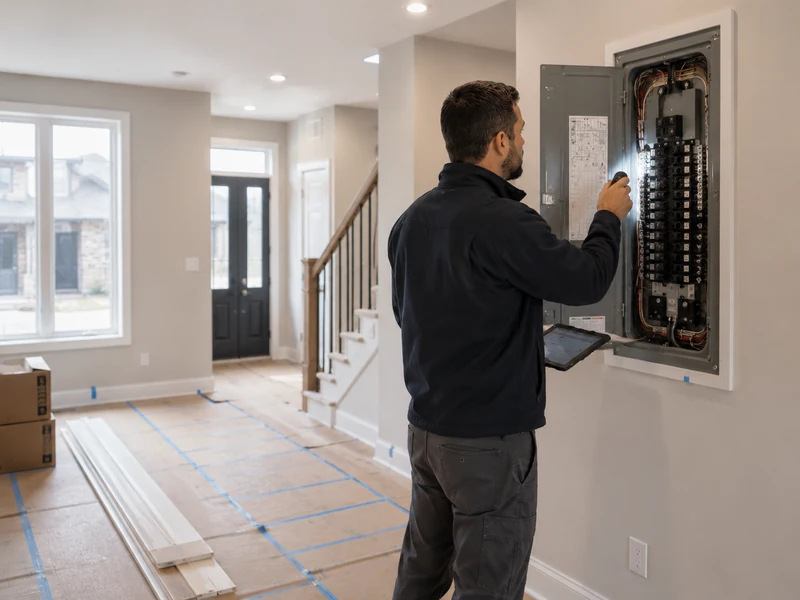
A new home comes with warranty coverage, and that coverage runs on deadlines. Miss a submission window and an item that would have been the builder's responsibility quietly becomes yours. The inspections exist to make sure the list you submit is complete and credible.
Three moments that matter
New-home warranty in Ontario is administered under the Tarion framework, and there are three points where a documented list of deficiencies is worth having:
- The pre-delivery inspection — walking the home with the builder before you take the keys, and recording its condition at handover.
- The 30-day list — submitted in the first month of possession, once you have lived in the house and used its systems.
- The year-end list — submitted near the end of the first year, by which point seasonal movement and settlement have shown up.
Confirm the current submission windows and forms directly with Tarion for your home — the dates are tied to your possession date, and warranty administration changes over time. An inspection tells you what to submit; it does not extend a deadline.
Why a new home still needs inspecting
New construction is not defect-free construction. It is built quickly, by many trades, often in weather. The recurring findings are rarely dramatic — incomplete attic insulation, missing or reversed vapour barrier, unsealed penetrations, poor grading, drainage that discharges against the wall, HVAC that was never balanced, and a long tail of finish deficiencies that are easy to overlook when you are excited about the house.
Buyers also tend to inspect the wrong things. Finish items are visible and get written down; the attic, the mechanical room and the exterior drainage are the ones that cost money later.
What makes a list credible
A warranty submission is a document that someone else reads and acts on. It is far more effective when each item is specific, located and photographed — "insufficient insulation depth at the north-west corner of the attic, measured against the specified value" rather than "attic not finished properly."
That is the practical value of having an inspection before you submit: not that you could not have found the items yourself, but that the list arrives in a form the builder can act on and is harder to dismiss.
What tends to be found at each stage
The three inspections find different things, because different problems become visible at different times.
At pre-delivery, the findings are largely about completion and workmanship: unfinished items, damaged finishes, missing hardware, and whatever the trades left behind. It is also the moment to record the condition of everything, so that damage arriving later is clearly not yours.
At thirty days, the house has been lived in. Systems have run, showers have been used, and the failures are functional: HVAC that does not deliver to some rooms, drainage that is slow, doors and windows that do not seal, and the first signs of water where water should not be.
At year end, the building has been through a full Ontario cycle of freeze, thaw and heat. This is where seasonal movement shows — drywall cracking at corners, doors that no longer latch, grading that has settled, caulking that has failed, and any envelope detail that was marginal to begin with.
Why an independent inspection, when the builder walks you through
The pre-delivery walk-through is conducted with the builder's representative, whose job is to hand over the house. That is not adversarial, but it is not independent either, and it moves quickly. Buyers are typically seeing the finished home for the first time and are in no position to assess an attic or a mechanical room in the time available.
An independent inspection is simply a second set of eyes with no interest in how fast the list gets closed — and one that goes into the spaces a walk-through does not.
Keep your own record
Photograph everything at handover, keep every submission and every response, and note the date each item was reported. Warranty disputes are resolved on documentation. A dated, photographed, specific list is worth considerably more than an accurate memory.
The deadline people miss
The year-end one. The 30-day list gets attention because you have just moved in and everything is fresh. Eleven months later, life is busy, the house feels normal, and the window closes quietly. If you do nothing else, put the year-end date in your calendar the week you move in.
Booking an inspection in the Greater Toronto Area, or want this discussed against your own property?